Online orders are back! • ⚠️ Beware of scams and fake accounts • Our official Instagram is @mahalekshmisilks• For enquiries, use the contact numbers listed in our official social media video descriptions
Online orders are back! • ⚠️ Beware of scams and fake accounts • Our official Instagram is @mahalekshmisilks• For enquiries, use the contact numbers listed in our official social media video descriptions

How to Style a Dhavani Set: Looks for Every Occasion (Girls' Guide)
Date: 15 May 2026
One of the most common questions we hear at Mahalekshmi Silks is: "Which dhavani should I choose for this occasion?" And the answer is never one-size-fits-all. A dhavani for a school Onam celebration is very different from one worn at a cousin's wedding, which is again different from what a girl wears for her half-saree ceremony.
This comprehensive guide walks you through exactly which dhavani to choose — fabric, colour, embellishment level, and styling — for every major occasion in a Kerala girl's life.
1. Dhavani for Onam
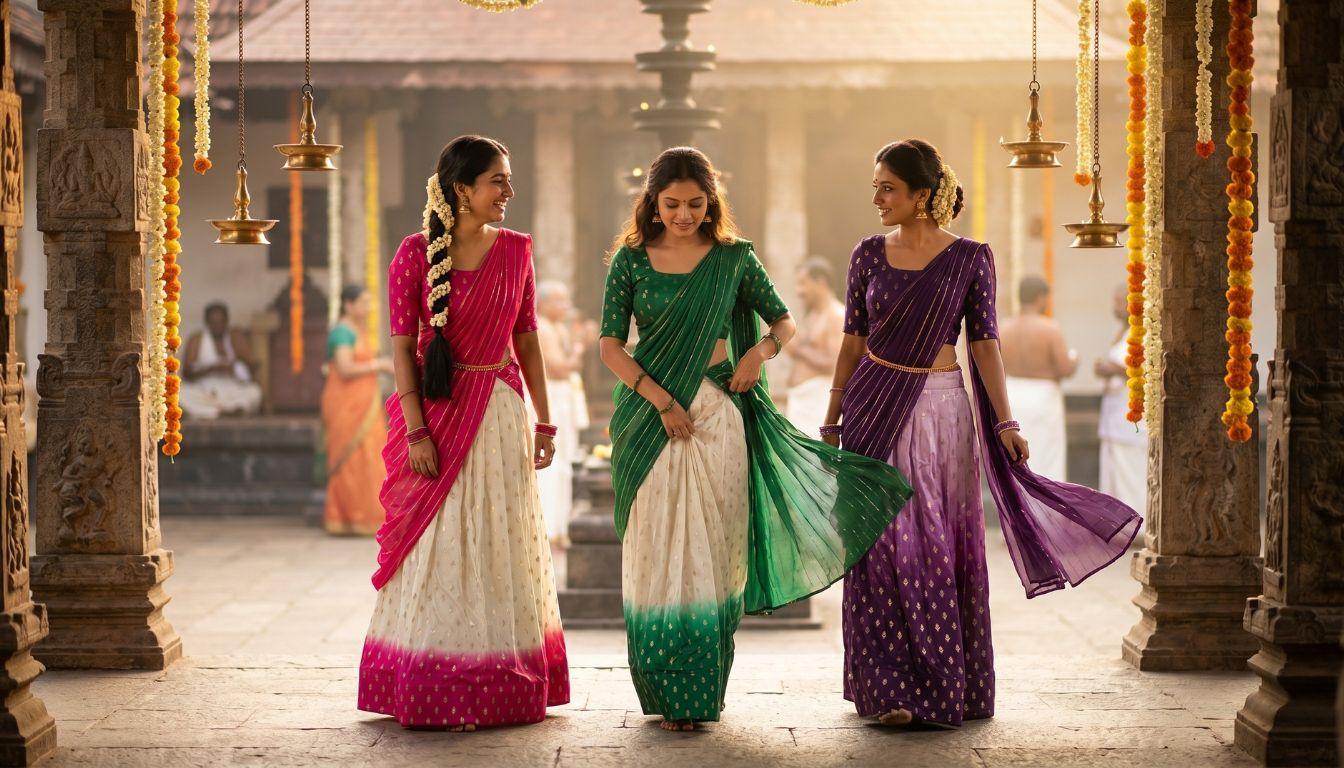
Onam is Kerala's most beloved festival and the occasion when traditional clothing is celebrated most widely. Dhavanis are among the most popular outfit choices for teenage girls during Onam.
The Traditional Look: The purest Onam dhavani is the kasavu dhavani set — a cream or off-white dhavani with golden kasavu (zari) borders. This combination reflects the simplicity, elegance, and agricultural roots of the festival. It pairs beautifully with simple gold jewellery — a thin necklace, small earrings, and glass bangles.
The Festive Contemporary Look: Modern Onam celebrations also embrace peacock blue, emerald green, deep red, and mustard yellow dhavanis with gold borders. These bring festive colour to the celebrations while maintaining a traditional silhouette.
Best Fabrics for Onam: Semi-silk and cotton silk are ideal — they are comfortable in warm weather, drape beautifully in the heat, and photograph wonderfully in outdoor Onam settings.
Jewellery Tip: Keep jewellery simple for Onam. The kasavu border does the heavy lifting. A temple-design gold necklace, simple gold jhumkas, and a thin gold bangle set is perfect.
2. Dhavani for the Half-Saree Ceremony
This is the most significant occasion in a girl's traditional calendar — her first formal wearing of the dhavani, marking her transition to womanhood. The outfit for this occasion deserves the highest level of attention and investment.
Fabric: Nothing less than pure silk is traditionally appropriate. Kanchipuram silk, soft silk, or Mysore silk sets are all excellent choices. The richness of a pure silk dhavani set communicates the importance of the occasion.
Colour: Red and gold is the most traditional choice for the half-saree ceremony, echoing bridal imagery. Deep green with gold borders, royal blue with silver zari, and rich burgundy with gold are all beautiful alternatives.
Embellishment: This is the one occasion where you do not hold back. Heavy zari borders, woven buttas across the skirt body, embroidered blouses, and a richly worked dupatta are all appropriate.
Styling: The fan-pleat drape described in our draping guide is the most appropriate styling for this occasion. The hair is typically styled in a traditional braid with flower garlands (jasmine or rose). Jewellery is elaborate — usually a full set including necklace, earrings, bangles, armlets, and a waist belt (odyanam) if available.
3. Dhavani for Weddings
When attending a wedding as a guest, a girl's dhavani should reflect the celebratory tone of the occasion without upstaging the bride. Kerala weddings have a distinct aesthetic — often more understated than north Indian weddings, with elegance over extravagance.
Fabric: Banarasi silk, semi-silk, or soft silk dhavanis are ideal for weddings. They have enough weight and sheen to look special without being overly theatrical.
Colour: Jewel tones work beautifully at weddings — sapphire blue, bottle green, deep magenta, rich maroon, or teal. Avoid white (reserved for religious/mourning contexts in Kerala), and avoid red if you do not want to risk colour-clashing with the bride.
Embellishment: Moderate. Beautiful woven borders, subtle buttas, and a contrasting dupatta with a fine border are perfect. Avoid outfits with excessive sequin or mirror work at traditional Kerala weddings; that level of embellishment is more suited to north Indian celebrations.
Jewellery: A gold set is standard and always appropriate. Temple-design jewellery works beautifully. If your daughter is older (15+), she can carry lightweight antique-finish jewellery for a more contemporary look.
4. Dhavani for Temple Festivals (Thrissur Pooram, Attukal Pongala, Vishu)
Temple festivals in Kerala have a distinct character — devotional, vibrant, and deeply traditional. The outfit should reflect respect for the sacred setting while also celebrating the festive atmosphere.
Fabric: Cotton silk or semi-silk are ideal for long outdoor temple festivals where comfort matters. Pure silk is appropriate for shorter, indoor temple celebrations.
Colour: Traditional festive colours — saffron yellow, deep red, peacock blue, and white with gold borders — are all appropriate. Avoid very dark colours like black for temple-going, as these are traditionally considered inauspicious in Hindu religious contexts.
Embellishment: Traditional woven motifs (elephant buttas, temple borders, floral patterns, peacock designs) are particularly meaningful for temple occasions.
5. Dhavani for School Cultural Programmes and Dance Recitals
School events have their own requirements — the outfit needs to be practical, allow movement, and look polished from a distance (since school audiences are often at a distance from the stage).
Fabric: Semi-silk is the gold standard for school events. It is affordable, durable, easy to manage, and looks excellent both close-up and from a distance.
Colour for Stage: On stage, bright and saturated colours read better than pastels under stage lighting. Deep blues, bright reds, vivid greens, and mustard yellows are all stage-friendly choices.
Embellishment: Moderate. Woven buttas and clean borders look clean from a distance. Avoid heavily embellished or sequinned sets for school stage events — under bright stage lights, excessive glitter can be visually distracting.
Practical Considerations: Make sure the dupatta is securely double-pinned so it does not slip during active movement. Choose a skirt with enough gather that your daughter can take long dance steps without restriction.
6. Dhavani for Engagement Ceremonies and Pre-Wedding Celebrations
When attending or participating in engagement ceremonies, mehendi functions, or family pre-wedding gatherings, a dhavani in the middle register of formality works beautifully.
Fabric: Organza is an excellent choice for these semi-formal celebrations — it has a contemporary, sophisticated quality while remaining unmistakably traditional.
Colour: Pastels and medium-saturation colours are perfectly appropriate here. The Cream and Bottle Green Organza Dhavani Set is ideal — it looks sophisticated and celebratory without the heaviness of a full wedding outfit.
Jewellery: Delicate polki or uncut diamond sets, pearl necklaces, or contemporary gold designs pair beautifully with organza dhavanis.
7. Dhavani for Birthday Celebrations and Personal Occasions
Not every dhavani is worn for a formal or religious occasion. Birthday celebrations, family get-togethers, and personal milestones are perfect opportunities to wear dhavanis that reflect personal taste and style.
Approach: These are the occasions to be playful with colour and embellishment. If your daughter loves a particular colour combination, this is when to embrace it fully.
Fabric: Semi-silk or organza — comfortable, beautiful, and easy to wear.
Styling: Contemporary blouse cuts, statement earrings, and modern hair styling work beautifully here. A dhavani can be styled in a thoroughly modern way while remaining grounded in tradition.
Shop Occasion-Ready Dhavani Sets at Mahalekshmi Silks
Whether you are preparing for your daughter's half-saree ceremony, an upcoming Onam celebration, a wedding guest appearance, or a school cultural event, Mahalekshmi Silks has the perfect dhavani set for every moment.
Our collection spans every fabric and formality level — from pure silk to light organza, from heavily worked ceremonial sets to simple, elegant semi-silk daily wear. Explore our dhavani collection to find the right set for your next occasion.
Can my daughter wear the same dhavani for both Onam and a temple visit?
Yes, a traditional kasavu dhavani or a semi-silk dhavani in white and gold works beautifully for both. Versatile jewel-tone sets can also transition between festive and temple occasions.
My daughter is attending a wedding reception, not the ceremony — does the formality change?
Reception events in Kerala are often slightly more relaxed than the ceremony itself. A Banarasi or semi-silk dhavani in a festive colour is perfectly appropriate — you need not go full pure silk.
Are there any colours to absolutely avoid at Kerala occasions?
At temple visits and religious ceremonies, avoid black as a primary colour — many families consider it inauspicious for devotional settings. White is fine for temple but should be avoided at weddings where it is associated with mourning. Otherwise, colour choice is largely a matter of taste and tradition.
Is a dhavani the same as a pavadai sattai?
They are very closely related. Pavadai sattai is the Tamil term for the skirt (pavadai) and blouse (sattai) combination. When a dupatta is added to this, it becomes a pavadai dhavani or half saree. In Malayalam usage, the full three-piece set is simply called dhavani.
Can I buy a lehenga and wear it with a South Indian-style dupatta drape?
Yes, this fusion approach works well — particularly if the lehenga fabric and colour palette are in keeping with South Indian aesthetics (avoiding heavy north Indian embroidery in favour of silk-look fabrics). However, for ceremonial occasions like the half-saree ceremony, a traditional dhavani is more appropriate.
My daughter wants a lehenga for an Onam celebration. Is that okay?
The traditional Onam outfit is firmly in the dhavani/kasavu saree tradition. A lehenga is not incorrect, but it is not traditional for Onam. If the family celebration is relaxed and non-traditional, a lehenga is fine. For a formal Onam celebration with traditional elements, a dhavani is far more appropriate.
Are there Banarasi versions of both dhavanis and lehengas?
Yes. Banarasi fabric (the rich brocade woven in Varanasi) is used in both South Indian dhavani sets and north Indian lehengas. When a Banarasi dhavani set is made — like the Banarasi Semi Silk Dhavani Set in Moss Green and Off-White from our collection — it combines the rich Banarasi weave with a South Indian silhouette and dupatta style, creating a beautiful east-meets-south fusion.