Online orders are back! • ⚠️ Beware of scams and fake accounts • Our official Instagram is @mahalekshmisilks• For enquiries, use the contact numbers listed in our official social media video descriptions
Online orders are back! • ⚠️ Beware of scams and fake accounts • Our official Instagram is @mahalekshmisilks• For enquiries, use the contact numbers listed in our official social media video descriptions

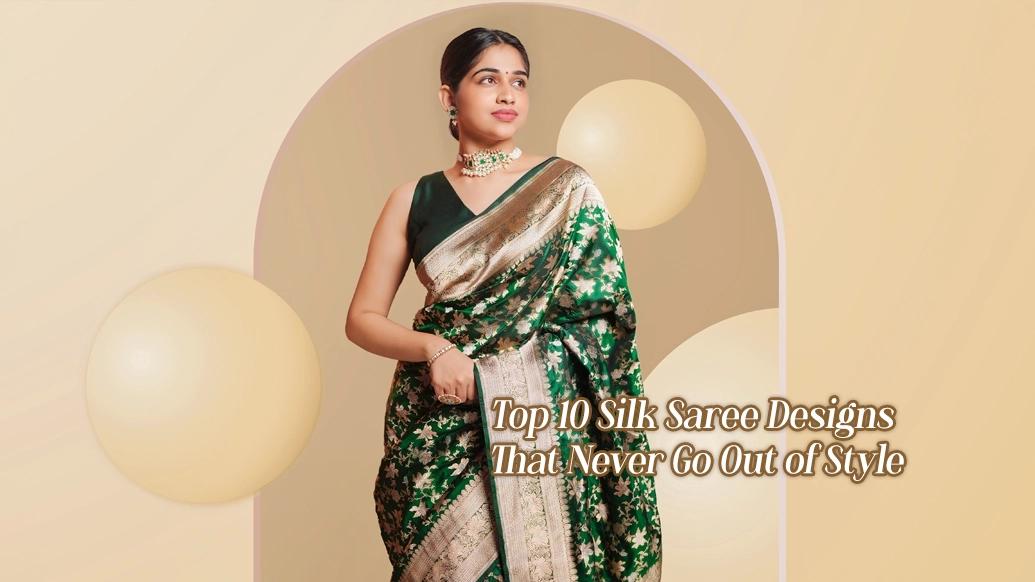
Top 10 Silk Saree Designs That Never Go Out of Style
Date: 18 June 2025
There is something deeply retro about silk sarees. Tradition, elegance, and heirloom-quality craftsmanship sew an emotion into the silk saree, a garment that is both culturally rooted and ever-evolving. From temple rituals to society weddings, these luxurious drapes have accompanied Indian women through every epoch-defining moment. Over time, just a small portion of the enormous variety of patterns and motifs has persisted. These are the sarees that are never out of place, those that pass from mothers to daughters with tales, morals, and an elan that cannot be swayed by fashionable times. These are the ten silk saree designs that continue to be the height of refinement, year by year.
The Silk Queen: Kanjivaram Silk Sarees
The well-known Kanjivaram must be mentioned at the beginning of any countdown to silk sarees. Kanjivarams, which are native to the Tamil Nadu town of Kanchipuram, are renowned for their vibrant hues, temple-shaped borders, and offset pallus made with real zari. A Kanjivaram is typically selected for wedding trousseaus and temple functions, due to its beauty and symbolic connection with tradition. Be it a vibrant red with a gold rim or a soft pastel with fine details, the Kanjivaram flows elegantly well into each era and personality. The dense weave and sheen render it a top choice for special events, making it a classic of all time.
Banarasi Sarees Silk: Mughal-Era Luxury
Embroidered on Threads Influenced by Persian art and Mughal attention to detail, the sarees are covered with elaborate brocade work, floral motifs, and metallic zari patterns that talk of richness. What keeps them evergreen is their unparalleled capacity to mix tradition with royal sophistication. Often chosen by North Indian brides, a Banarasi saree in shades of maroon, gold, or pink is not just a garment—it's a celebration in itself. Pair it with traditional jhumkas and a sleek bun, and you've got a look that's eternally graceful.
Mysore silk sarees: The pinnacle of elegance and simplicity
Originally from Karnataka, Mysore silk sarees typically have simple designs, delicate zari borders, and single hues, which makes it an apt choice for official gatherings, office parties, or small festive celebrations. Its subtle charm is exactly what renders it ageless—it does not shout for attention; it merely demands it.
Chanderi Silk Sarees: Light-Weight Charm for Day-to-Day
The village of Chanderi in Madhya Pradesh is where these sarees, which are known for their airy texture and translucent fabric, first appeared. Chanderi silk sarees are ideal for women who like elegance without complication. Adorned with nature-inspired motifs—such as peacocks, lotuses, and geometrical designs—these sarees are usually worked in a combination of silk and cotton. These sarees are known for their silky drape and understated elegance due to their smooth texture and simplistic design.
Paithani Sarees: Maharashtrian Pride in Every Weave
The Paithani silk saree is not a drape; rather, it is a work of Maharashtra art and culture. Popular for its peacock and lotus designs, along with a characteristic pallu that is usually embellished with bright colors and golden zari, this saree is a work of art. A traditional Paithani saree is an heirloom treasure among most Maharashtrian families. That it can merge regal sophistication with individual history allows it to rank among the most popular and enduring fashion trends. Whether it's for a wedding event or Ganesh Chaturthi, Paithani never lets you down.
Patola Sarees: The Double Ikat Marvel from Gujarat
The Patola saree from Patan, Gujarat, is the most expensive and time-consuming saree in India. These dual-ikat technique-created, symmetrical sarees require months of labor to produce. They are rich and distinctive due to their bold colors and geometric shapes. Their geometric shapes and bold colors make them classy and unique. Even though they are so intricately designed, the Patola sarees are highly wearable and comfortable because they use silk. With this combination of comfort, nobility, and bold artistry, they become an immortal wealth for the connoisseur today.
Tussar Silk Sarees: Rustic Charm with Earthy Hue
It is commonly called "wild silk" because tussar silk is made from silkworms that are raised in jungles. They are valued for their lustrous texture and down-to-earth colors like sand, copper, gold, and beige. They are not as shiny as Kanjivarams or Banarasis, but carry a raw beauty that has an appeal in its simplicity. Typically hand-painted or block-printed with tribal motifs or floral designs, Tussar sarees are a designer's dream come true and an eco-fashionista's pick. They have a certain understated quality that makes them ageless and perfect for ethnic as well as contemporary fashion.
Raw Silk Sarees: A Bold, Textured Classic
Raw silk sarees are for people who love their silk a bit firm. Because of their thick texture, mild stiffness, and matte finish, raw silk sarees can be draped easily and kept in good condition. For semi-formal occasions and family gatherings, raw silk sarees are always in style. They are available for purchase in vibrant solid colors or with exquisite embroidery. Their strength and adaptability give them a timeless beauty, and they are a bold cut that can be owned by any figure. Whether worn for a temple tour or a celebration meal, a raw silk saree is always a hit.
Baluchari Sarees: Using Silk to Tell Tales in West Bengal
Baluchari sarees are really works of storytelling. Made with silk yarns, the pallu in a Baluchari saree tends to tell scenes from an epic such as the Mahabharata or Ramayana. The sarees are usually available in rich hues of maroon, purple, green, or blue with elaborate detailing done in gold or silver yarn. Their narrative art style renders them timeless, and they're often congregated not only for masquerade but also due to the loveliness and stories they embody. A Baluchari saree is literature, history, and textile brilliance—dressed up in one.
Dharmavaram Silk Sarees: Bridal Luxury with Southern Soul
Andhra Pradesh's Dharmavaram sarees are confused with Kanjivarams as they possess broad borders and opulent weaves. But these sarees are unique thanks to the enameled contrasting color and temple borders, which otherwise find themselves edged with understated gold zari. They are utilized most commonly for wedding ceremonies and religious rituals due to their majesty and traditional style. In particular, Dharmavaram sarees, with their soft glow and tight weave, are royal and strong, and so they constitute an invaluable gem for eternity.
How do I recognize an original Kanjivaram or Banarasi silk saree?
Handwoven, original Kanjivaram and Banarasi sarees are occasionally embellished with genuine zari using gold or silver threads.
Is it OK to wear silk sarees to work or informal settings?
Sarees made of Mysore, Chanderi, and Tussar silk are light and breathable, making them appropriate for semi-formal gatherings, casual occasions, and the workplace. Their beauty is in simplicity, and they look great with little jewelry.
Can the next generation style silk sarees in a modern way?
Yes, definitely! Silk sarees are extremely versatile. Younger wearers generally style them with belted draping, crop top-style blouses, contemporary jewellery. This mix look has tradition but a modern spin.
Is handloom silk saree an investment?
Yes. Handloom silk sarees, particularly ones like Patola, Baluchari, and Kanjivaram, are not mere articles of clothing but heirlooms. Their quality, sturdiness, and cultural significance make them a lifetime possession.
Do all silk sarees drape heavily and rigidly?
Not necessarily. Whereas sarees such as Kanjivaram or Dharmavaram sarees are heavier in weight because of their thick weave and zari work, the likes of Tussar, Chanderi, or Mysore silk sarees are quite light in weight and easier to drape, particularly for casual or everyday wear.
Which silk saree would be appropriate in hot and humid conditions like Kerala or West Bengal?
For hot and muggy weather, choose for light silks like Chanderi, Tussar, or Mysore silk. They are lighter, more ventilated, and provide greater air flow, thus cooler and fashion-worthy too.