Online orders are back! • ⚠️ Beware of scams and fake accounts • Our official Instagram is @mahalekshmisilks• For enquiries, use the contact numbers listed in our official social media video descriptions
Online orders are back! • ⚠️ Beware of scams and fake accounts • Our official Instagram is @mahalekshmisilks• For enquiries, use the contact numbers listed in our official social media video descriptions

Manthrakodi Saree – The Sacred Silk of Kerala Weddings
Date: 29 May 2026
Every Kerala wedding contains one moment that stands apart from all the colour, celebration, and ceremony around it. That moment is the Manthrakodi — the instant the groom lifts a fold of pure silk and drapes it over the bride as the priest's voice rises in Vedic chant. In that single gesture, a thousand years of tradition, a family's love, and the blessing of Goddess Lakshmi herself converge.
This guide is the most comprehensive resource available on the manthrakodi saree. It is written for Kerala brides preparing for their wedding, for families seeking to honour their tradition with full knowledge, and for anyone who has witnessed this ritual and wanted to understand the profound depth behind what appears to be a simple act of draping silk.
At Mahalekshmi Silks we have had the privilege of supplying Manthrakodi sarees to thousands of Kerala families across generations. We have seen this ritual performed in grand temple mandapams and in intimate ancestral homes. We understand that choosing the right Manthrakodi is not a shopping decision — it is an act of devotion.
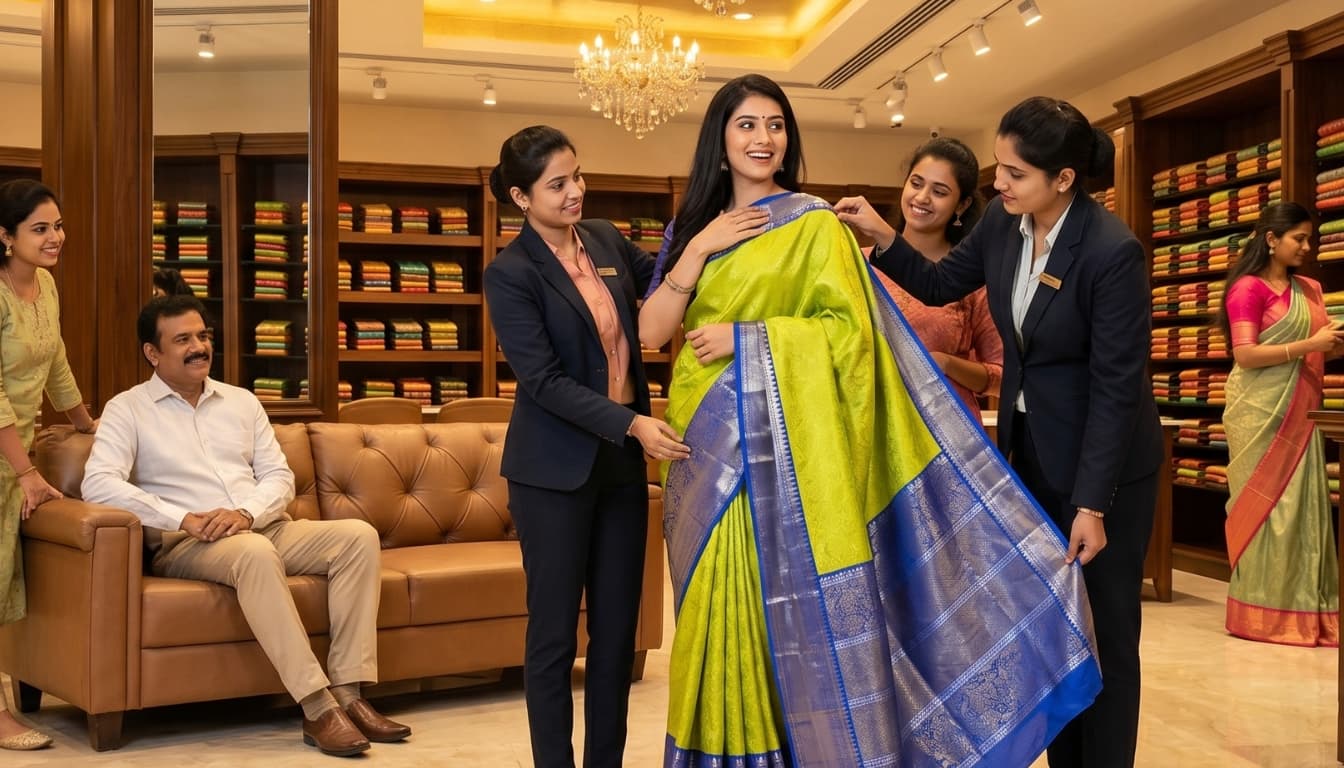
Why is the Manthrakodi the Most Sacred Garment in a Kerala Wedding?
Kerala Hindu weddings are distinguished by their ritual precision and spiritual depth. Unlike traditions that emphasise spectacle, the Kerala wedding — particularly among Nair, Namboothiri Brahmin, and Tamil Brahmin communities — is built around a series of sacred acts, each carrying specific theological meaning. The Manthrakodi ritual is the pinnacle of this sacred architecture.
The Groom's Vow Made Visible
When the groom drapes the Manthrakodi, he is not performing a ceremonial gesture. He is making a binding, publicly witnessed, spiritually ratified vow. The Vedic mantras chanted in that moment invoke specific divine forces as witnesses to his promise. In the cosmology of Kerala Hindu tradition, a vow made in the presence of these invoked energies is considered as binding as any contract. The saree becomes the material proof of that vow — something the bride can touch, wear, and preserve as a reminder of the promise made on her wedding day.
The Invocation of Goddess Lakshmi
The mantras chanted during the Manthrakodi ritual are specifically addressed to Goddess Lakshmi, the presiding deity of prosperity, grace, fertility, and marital harmony. The priest's chanting is not recitation — it is invocation. The belief embedded in this ritual is that the goddess herself attends the ceremony and imparts her blessing into the saree at the moment of draping. This is why the Manthrakodi saree is treated with such reverence long after the wedding day — it is considered to permanently carry Lakshmi's presence.
The Bride's Threshold Crossing
In Kerala Vedic tradition, the moment the Manthrakodi is draped represents a profound ontological shift for the bride. She formally crosses the threshold between two identities: she ceases to be solely her parents' daughter and becomes, simultaneously, her husband's wife and her new family's daughter-in-law. This is not merely a social transition — it is a spiritually ratified transformation. The Manthrakodi saree, draped precisely at this moment, is the tangible marker of that crossing.
The Family's Collective Acceptance
Because the Manthrakodi is chosen and gifted by the groom's family — not the groom alone — it carries the acceptance of an entire lineage, not just one person. The mother who helps select the saree, the grandmother whose aesthetic preferences quietly shape the choice, the aunt who wraps it in silk cloth before the ceremony — all of them participate in this act of welcome. The Manthrakodi is the groom's family saying, in the most formal spiritual language available to them: "you are ours now, and we are honoured to receive you."
Heirloom Status and Generational Memory
Many Kerala families do not simply store the Manthrakodi saree after the wedding. They preserve it as a sacred object. It is wrapped in cotton muslin, stored in the family almirah alongside other ritual items, and brought out only on auspicious occasions. In numerous families we have served at Mahalekshmi Silks, a grandmother's Manthrakodi has been passed to her granddaughter on her wedding day — not as a used garment but as a blessing, a continuity, a thread connecting the generations. This is the fullest expression of what the Manthrakodi truly is: not just a saree, but a living piece of family memory.
How is the Manthrakodi Ritual Performed? A Step-by-Step Guide
Understanding the ritual sequence is important for every bride and family preparing for a Kerala Hindu wedding. Here is the full Manthrakodi ceremony described precisely, as we have observed and participated in it across thousands of Kerala weddings.
1. Preparation Before the Ceremony
The Manthrakodi saree is prepared before the wedding day. In many families, the silk is placed in the puja room alongside flowers and lit lamps the evening before, allowing the saree to absorb the energy of prayer overnight. Some families take the saree to the family temple for a brief blessing before the wedding. At Mahalekshmi Silks, we recommend storing the Manthrakodi separately from other garments, wrapped in a clean cloth, until it is needed.
2. The Priest Initiates the Chanting
At the auspicious muhurtham determined by the astrologer, the family priest takes his position at the homa kund, the sacred fire altar. He begins reciting the Vivaha Sukta mantras from the Rigveda — the specific Vedic hymns prescribed for the Manthrakodi ritual. The mandap falls silent. The chanting creates a sonic field that, in the Vedic understanding, prepares the space for the divine presence to be invoked.
3. The Saree is Sanctified
The Manthrakodi saree is brought into the chanting space. In some community traditions, particularly among Namboothiri Brahmin families, the saree is briefly passed through the smoke of the homa fire — a purification act that is considered to make the garment fit to touch the bride's body during this sacred moment. In other traditions, the priest chants directly over the folded saree, directing the mantra energy into the cloth.
4. The Groom Receives the Manthrakodi
The saree is handed to the groom by his mother or the senior-most female relative of his family who is present. This act is deliberate and meaningful — the mother, who has chosen and purchased this saree with love, now entrusts it to her son to present to his bride. In this moment, the entire family participates through this single representative gesture.
5. The Draping — The Sacred Centrepiece
As the priest's chanting builds toward its peak invocation, the groom turns to the bride and gently drapes the Manthrakodi over her head and shoulders. He places the saree carefully, ensuring the pallav falls on the correct side according to tradition. This is the exact moment the ritual is named for — the simultaneous occurrence of the sacred chant and the physical draping. In Vedic belief, the garment and the mantra become one in this instant.
6. Elder Blessings
Immediately after the draping, the priest completes the final section of the Manthrakodi mantras. The bride and groom together receive blessings from the eldest members of both families. The bride, now wearing the Manthrakodi, touches the feet of the elders as a gesture of respect and seeks their blessings for her new life. This sequence formally closes the Manthrakodi ritual.
What Types of Silk are Used for Manthrakodi Sarees?
The type of silk chosen for a Manthrakodi saree is not merely a style decision — it is a statement about family tradition, regional identity, community values, and the depth of one's engagement with the ritual. Each silk type carries its own history, its own aesthetic vocabulary, and its own relationship to the sacred.
Kanjivaram Manthrakodi Saree
The Kanjivaram Manthrakodi is the most widely chosen and ceremonially grand option available. Woven in Kanchipuram, Tamil Nadu — a city that has been a centre of sacred textile production for over a thousand years — Kanjivaram silk is produced using mulberry silk thread combined with pure gold or silver zari. The hallmark of an authentic Kanjivaram is the interlocking warp and weft structure: the body and border are woven separately and then joined, creating the characteristic durability that allows these sarees to survive for generations.
For Manthrakodi use, the Kanjivaram saree is selected for its visual authority. The wide zari border — ranging from four to eight inches in width — carries motifs with specific sacred meanings. The temple gopuram border pattern represents the gateway to the divine. The peacock, vehicle of Saraswati, represents wisdom and grace. The lotus, sacred to Lakshmi, represents the goddess's blessing directly. The coin or rudraksha border represents the continuity of prosperity through generations. When a Kanjivaram Manthrakodi enters the mandap, its weight and lustre signal the seriousness and depth of the occasion.
The most auspicious Kanjivaram Manthrakodi colour combinations in Kerala tradition are red body with green border, green body with red border, yellow body with green border, and deep crimson with wide gold zari. These are not arbitrary aesthetic choices — the colour combinations correspond to specific planetary energies and are often prescribed by the family astrologer based on the bride's nakshatra and the wedding date's planetary chart.
Kerala Kasavu Manthrakodi Saree
The kasavu Manthrakodi represents Kerala's own indigenous textile tradition — one that predates the widespread use of Kanjivaram in Kerala wedding ceremonies by centuries. Woven on traditional handlooms in the weaving villages of Balaramapuram near Thiruvananthapuram, Chendamangalam in Ernakulam district, and Kuthampully in Thrissur district, the kasavu saree is a product of Kerala's cultural self-expression in textile form.
The aesthetic of the kasavu Manthrakodi is built on restraint and purity. The saree body is woven in cream or off-white cotton-silk or pure silk, and the border carries kasavu — real gold thread worked into the fabric's edge in patterns that range from a simple single stripe to elaborate multilayered temple borders. This combination — pure white body, gleaming gold border — is the visual language of auspiciousness in Kerala. White represents Saraswati, purity, and new beginnings. Gold represents Lakshmi, prosperity, and divine grace. Together, in the kasavu Manthrakodi, these two principles unite to dress the bride in the full benediction of the divine feminine.
Namboothiri Brahmin families consider the kasavu Manthrakodi the only authentically correct choice. Nair families in traditional households overwhelmingly prefer it. When a bride wears the kasavu Manthrakodi, she is not merely wearing a beautiful saree — she is wearing the living textile memory of Kerala's civilisation.
Mysore Silk Manthrakodi Saree
Mysore pure silk offers the grandeur of silk with significantly less weight than Kanjivaram. Woven by the Karnataka Silk Industries Corporation in Mysore, these sarees carry a characteristic softness and natural sheen. For Manthrakodi use, Mysore silk is an appropriate choice for brides who prefer comfort across a long ceremony without sacrificing the purity of silk. Available in soft pastels, ivory tones, and quiet gold, Mysore silk Manthrakodi sarees are particularly well-suited to warm-weather weddings.
South Indian Pattu Manthrakodi Saree
Pattu sarees — a broad category of South Indian silk weaves — offer a range of weights, border styles, and colour combinations that allow contemporary brides to honour the Manthrakodi tradition while incorporating a more personal aesthetic expression. Produced in various weaving centres across Tamil Nadu, Andhra Pradesh, and Telangana, pattu Manthrakodi sarees offer vivid contrast borders and bright colour combinations that work well for brides who want the ritual significance without the formality of Kanjivaram.
How to Choose the Right Manthrakodi Saree: An Expert Guide
At Mahalekshmi Silks, we have guided thousands of families through this decision. Here is what genuine expertise in Manthrakodi selection looks like.
Step 1: Establish Your Family's Silk Tradition
Before a single saree is examined, the family must answer one foundational question: has the Manthrakodi in your family historically been Kanjivaram or kasavu? This is not a trivial question. In many Kerala families, the answer is known without hesitation — it has been the same for five or six generations. If you are uncertain, ask your grandmothers or the family priest. Honouring this continuity has its own meaning beyond aesthetics: it connects your wedding to those that came before it in an unbroken line.
Step 2: Obtain the Astrologer's Colour Guidance
In the Kerala Hindu tradition, the colour of the Manthrakodi saree is not a free aesthetic choice. It is an informed ritual decision. The bride's janma nakshatra — her birth star — governs which colours are auspicious for her to wear at her wedding. The wedding date's planetary configuration further refines this. A good Jyotishi, or Vedic astrologer, will specify the ideal colour for the Manthrakodi along with the wedding muhurtham calculation. This consultation should happen before any saree shopping begins.
Step 3: Verify Pure Silk Certification
The Silk Mark, issued by the Central Silk Board of India, is the only credible certification that a saree is made from 100% pure silk. This is the minimum documentation required when purchasing a Manthrakodi. Beyond the Silk Mark, ask the merchant specifically about the silk's origin (Kanchipuram for Kanjivaram, Balaramapuram or Kuthampully for kasavu), the zari composition (pure gold, gold-plated copper, or aluminium), and the weaver's registration details. A trustworthy merchant will provide all of this information without hesitation.
Step 4: Evaluate the Zari Quality
Zari quality is the single most important factor in a Manthrakodi saree's long-term preservation. Real gold zari — called real zari or pure zari in the trade — uses actual gold wire wrapped around a silk core thread. It retains its colour and lustre indefinitely and is immune to tarnishing. Gold-plated copper zari (imitation zari) is a legitimate and significantly more affordable alternative that retains its appearance well if stored correctly. Aluminium-based zari — the cheapest option — will tarnish to a dull grey within a few years, making the saree unsuitable as a long-term heirloom. For a Manthrakodi saree intended to be preserved across generations, real zari or high-quality imitation zari is essential.
Step 5: Assess Border Width and Motif Appropriateness
The border of a Manthrakodi saree carries its meaning visually. For ceremonial Manthrakodi use, the border should be wide — a minimum of five inches is the traditional standard, with eight-inch borders on grand Kanjivaram pieces being particularly appropriate for formal ceremonies. The motifs within the border should come from the classical temple vocabulary: gopuram arches, peacocks, lotuses, coin patterns, or hamsa birds. Contemporary geometric borders or abstract patterns, while beautiful on everyday sarees, are generally considered too casual for the Manthrakodi ceremony by traditional families.
Step 6: Consider the Bride's Physical Comfort
A premium Kanjivaram Manthrakodi saree can weigh between 800 grams and 1.2 kilograms. For a bride who will be seated, standing, and performing rituals for four to six hours, this weight matters. Ask your silk consultant specifically about the weight of any saree under consideration. Many Kanjivaram weavers now produce lighter, "travel weight" versions of their classic designs — these maintain all the visual grandeur of the traditional saree while being significantly more comfortable for the bride.
Step 7: Examine the Pallav Carefully
The pallav is the end section of the saree — the portion that falls over the shoulder or drapes across the chest. It is the most visible element when the saree is worn and typically carries the most elaborate design work. For a Manthrakodi saree, the pallav should feature the richest zari work on the entire piece: a full scene from Hindu mythology, a dense temple border motif, or an elaborate peacock composition. The quality of the pallav is a reliable indicator of the overall quality of the weave.
Step 8: Purchase Only from an Established, Certified Silk Merchant
The Manthrakodi saree is not the occasion for experimenting with a new vendor or taking a risk on a discounted purchase. The consequences of buying a substandard saree — one that frays, tarnishes, or turns out to be blended rather than pure silk — extend beyond aesthetics. They touch the family's relationship with the ritual itself. Mahalekshmi Silks has been a trusted name in Kerala silk for generations, with direct relationships with Kanjivaram and kasavu weavers. When you buy your Manthrakodi from us, you buy the full chain of provenance, from the weaver's loom to your ceremony.
What is the Price of a Manthrakodi Saree in 2026?
Understanding the price range for a Manthrakodi saree is important for family budgeting and for making an informed choice that aligns both with your tradition and your resources. The price of a Manthrakodi saree is determined by four factors: the quality of the silk, the composition of the zari, the complexity of the weave and motifs, and the provenance of the weaving.
- Kerala Kasavu Manthrakodi — Cotton-Silk Variant: ₹5,000 to ₹18,000. This is an entry point into the kasavu tradition, appropriate for families on a moderate budget who wish to honour the authentic Kerala Manthrakodi style with a handloom piece. The cotton-silk blend is lighter and more comfortable but carries less of the deep lustre of pure silk.
- Kerala Kasavu Manthrakodi — Pure Silk Variant: ₹15,000 to ₹45,000. Woven entirely from pure silk with genuine kasavu gold thread in the border. This is the standard choice for families who are committed to material authenticity in the Manthrakodi tradition and have a moderate to comfortable budget.
- Kanjivaram Manthrakodi — Standard Weave: ₹18,000 to ₹55,000. Pure Kanjivaram mulberry silk with quality zari work. Offers the full visual grandeur and draping weight that makes Kanjivaram so well suited to the Manthrakodi ceremony. This is the most commonly purchased price range among families across Kerala.
- Kanjivaram Manthrakodi — Premium Zari Weave: ₹45,000 to ₹1,00,000. Elaborate weave with intricate motif work, wider zari borders, and higher-quality zari composition. A statement piece that announces its own significance in the mandap.
- Kanjivaram Manthrakodi — Real Gold Zari — Heirloom Grade: ₹90,000 to ₹2,50,000 and above. Woven with actual gold-wire zari by master craftspeople. These are permanent investments — sarees that will outlast every other garment in the family, preserve their beauty across decades, and carry increasing sentimental and material value with each passing generation.
How to Preserve a Manthrakodi Saree as a Family Heirloom
The Manthrakodi is designed to last. A genuine Kanjivaram or kasavu Manthrakodi saree, properly cared for, will not merely survive for decades — it will improve with age, the silk gaining a deeper lustre and the zari settling into a richer patina. Preservation is therefore not optional maintenance: it is an act of respect for the object and for the tradition it represents.
Dry Cleaning is Non-Negotiable
Pure silk and zari are incompatible with home washing by any method. Water causes silk proteins to swell and distort, permanently altering the weave. Zari threads — whether real gold or quality imitation — oxidise and tarnish irreversibly when exposed to moisture. After each wearing of the Manthrakodi saree, regardless of whether it appears dirty, take it to a professional dry cleaner who has demonstrable experience with Kanjivaram or kasavu silk. Ask specifically whether they have handled zari sarees before entrusting your Manthrakodi to them.
The Correct Storage Method
After dry cleaning, the saree should be carefully folded — or ideally loosely rolled — and wrapped in a clean, undyed, 100% cotton muslin cloth. The muslin must be undyed because synthetic dyes can transfer to silk over time. Never use plastic bags, bubble wrap, or zip-lock bags for saree storage. Plastic creates an airtight, moisture-trapping microenvironment that causes silk to yellow and zari to develop a greenish tarnish within months. Store the wrapped saree in a wooden almirah, ideally one made from or lined with camphor wood. Wooden storage breathes naturally, regulating humidity and preventing the conditions that damage silk.
Pest Deterrence with Traditional Materials
Silverfish and clothes moths are the two greatest biological threats to a stored silk saree. Both are deterred effectively by natural materials that have been used in Indian textile preservation for centuries. Place a small cloth bag of dried neem leaves or a few camphor balls in the almirah near the saree — close enough that the scent permeates the storage environment, but not in direct contact with the silk, as both neem and camphor can leave marks if they touch the fabric directly. Replace the camphor every three to four months and the neem leaves twice a year.
The Six-Month Refolding Practice
This is the most commonly neglected step in silk preservation, and also one of the most important. Every six months, remove the saree from storage, unfold it completely, allow it to breathe for a few hours in a shaded, well-ventilated space, and then refold it along entirely different crease lines before returning it to storage. The reason: every fold creates a point of stress in the silk fibre and the zari thread. If the saree is always folded in the same place, those stress points deepen over years into permanent crease marks that can eventually weaken the fabric. Changing the fold lines distributes the stress evenly and prevents any single line from becoming a permanent mark.
Annual Airing Ritual
Once a year, on a clear, low-humidity day — many families align this with Onam or Vijayadasami as an auspicious occasion — bring the Manthrakodi out of storage and allow it to breathe in a cool, shaded, well-ventilated space for two to three hours. Never place the saree in direct sunlight: UV radiation fades silk colours and degrades the silk protein irreversibly over time. This annual airing removes any accumulated moisture, refreshes the fabric, and allows you to inspect the saree for any early signs of damage that can be addressed before they worsen.
The Manthrakodi saree is not merely a garment. It is a record. It records the moment two families chose to become one. It records the groom's vow. It records the priest's invocation. It records the presence of the divine at a human ceremony. Every thread in a well-made Manthrakodi saree carries this record forward in time.
When you hold a Manthrakodi saree — feel the weight of the silk, trace the border motif, let the zari catch the light — you are holding something that has been made, used, and preserved in this way for a thousand years. The weaver in Kanchipuram who made it, the family in Kerala who will use it, the bride who will wear it, the grandmother who will keep it — all of them are part of a continuous human tradition of transforming silk and gold into sacred meaning.
At Mahalekshmi Silks, we are honoured to be part of that continuity. We invite you to explore our Manthrakodi saree collection and to speak with our silk consultants, who will bring the full depth of their knowledge and experience to helping you find the right saree for your ceremony.
What does Manthrakodi mean in Malayalam?
Manthrakodi means "the garment blessed by sacred chants" in Malayalam. It is a compound of Manthra (Vedic sacred chant or hymn) and Kodi (saree or sacred cloth). The name is a precise description of the ritual: the saree is physically present when the Vedic mantras are chanted and is therefore considered to absorb and carry those divine blessings permanently.
What is the significance of the Manthrakodi ritual in a Kerala wedding?
The Manthrakodi ritual is the spiritual centrepiece of the Kerala Hindu wedding ceremony. It marks the groom's formal vow of lifelong care for the bride, the blessing of Goddess Lakshmi on the union, and the bride's sacred transition from her birth family to her new family. In the Vedic tradition, a vow made during this mantra-chanting is considered divinely witnessed and therefore binding in the deepest possible sense. The ritual has been performed in Kerala for over a thousand years and remains unchanged in its essential structure.
Which is better for Manthrakodi — Kanjivaram or Kerala kasavu?
Neither is inherently better — both are equally sacred and appropriate. The correct choice depends on your family's tradition. Kanjivaram is preferred by Nair and Tamil Brahmin families and by those who want the visual grandeur of heavy silk and elaborate zari work. Kerala kasavu is preferred by Namboothiri Brahmin families and by those whose tradition is deeply rooted in Kerala's own textile heritage. If your family has no established preference, consult your family priest, who will often have a clear recommendation based on your community's customs.
What colour Manthrakodi saree is auspicious for my wedding?
The most auspicious colour for your Manthrakodi saree is determined by your birth star (janma nakshatra) and the planetary configuration of your wedding date, as interpreted by a Vedic astrologer (Jyotishi). As a general guide: red and its deep variations are widely considered auspicious across most communities; green symbolises fertility and growth; yellow represents wisdom and solar energy; cream and off-white (particularly for kasavu) represent purity and Saraswati's blessing. However, because this is a ritual choice rather than an aesthetic one, astrologer guidance is strongly recommended.
Can a Manthrakodi saree be worn after the wedding?
Yes, and many families actively encourage this. The Manthrakodi saree is considered permanently auspicious — it carries the blessings of the ritual for the entire life of the saree. Many Kerala brides wear their Manthrakodi on their first wedding anniversary, on Onam and Vishu, at the naming ceremonies (choroonu) of their children, and at other significant family occasions. The saree does not "use up" its auspiciousness by being worn again; if anything, each wearing adds to its personal and spiritual significance.
How long does a Manthrakodi saree last if properly cared for?
An authentic Kanjivaram or kasavu Manthrakodi saree, cared for correctly, can last between 50 and 100 years without significant deterioration. The Silk Mark-certified Kanjivaram sarees available at Mahalekshmi Silks use mulberry silk that is inherently durable, and the zari, if of real or quality imitation grade, retains its appearance across decades with proper dry cleaning and storage. The sarees we have seen handed down as heirlooms in Kerala families are often 40 to 60 years old and remain wearable.
Is it necessary for the Manthrakodi to be new?
In the traditional practice, the Manthrakodi should be a new saree purchased specifically for the wedding ceremony by the groom's family. However, there is a respected and emotionally significant alternative: in some Kerala families, a grandmother's or mother's Manthrakodi saree is passed down to the next bride as a deliberate act of heirloom transmission. This is considered equally — and in some families, more — auspicious, as the saree already carries the blessings of the previous ceremony. If your family wishes to use a preserved ancestral Manthrakodi, consult the family priest to ensure the saree is ritually prepared (cleaned and blessed) before the ceremony.
Where can I buy an authentic Manthrakodi saree in Kerala?
Authentic Manthrakodi sarees are available at certified silk merchants with direct relationships with Kanjivaram weavers and Kerala kasavu weavers. Look for: a Silk Mark certificate on the saree, clear provenance information (weaving centre and weaver details), a merchant with demonstrable expertise in Kerala bridal traditions, and a return or exchange policy. [Mahalekshmi Silks](https://mahalekshmisilks.com/) is among Kerala's most trusted sources for Manthrakodi sarees, offering Silk Mark-certified pieces across all price ranges with full consultant support.